Options Greeks Explained: Delta, Gamma, Theta, Vega & Rho
Options Greeks are mathematical sensitivity metrics that measure how an option contract's price changes in response to movements in the underlying asset price, time, implied volatility, and interest rates.
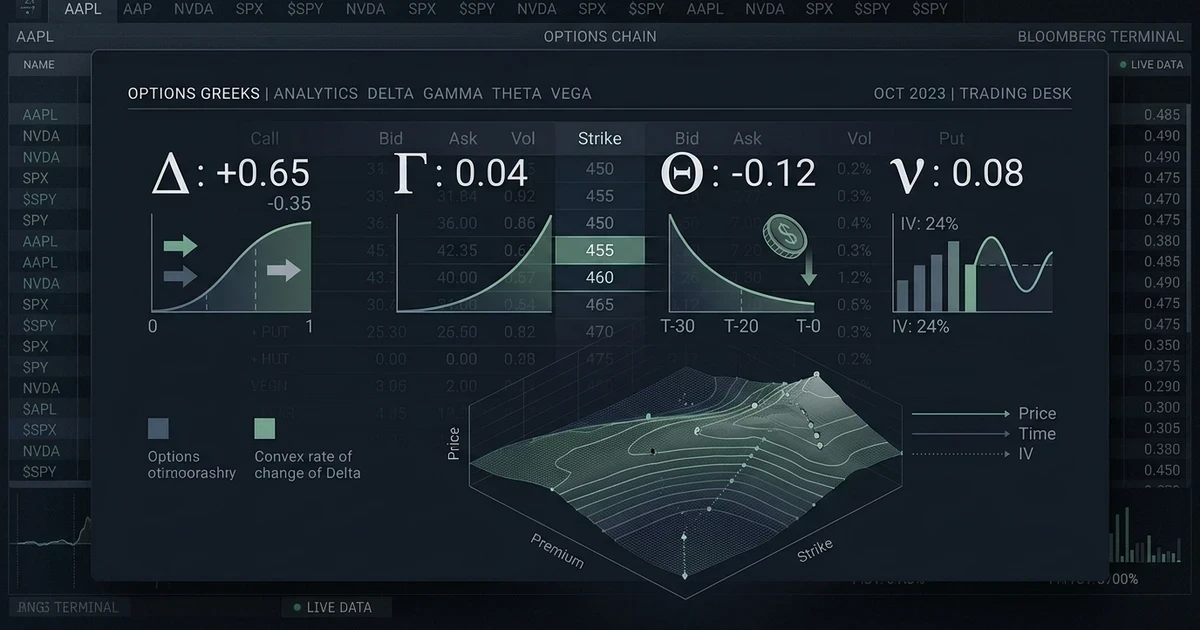
Key Takeaways
- Delta measures the rate of change in an option's price relative to a $1 move in the underlying stock — calls have positive delta (0 to +1), puts have negative delta (0 to -1).
- Theta represents time decay — the daily erosion of an option's extrinsic value as expiration approaches, working against option buyers and in favor of sellers.
- Vega measures sensitivity to implied volatility changes — a vega of 0.15 means the option gains or loses $0.15 for every 1% change in implied volatility.
- Gamma measures the rate of delta change per $1 move — highest for at-the-money options near expiration, creating dangerous 'gamma risk' for short options positions.
Professional options traders don’t simply buy calls or puts and hope for price movement. They manage a complex portfolio of risk exposures — collectively known as the Options Greeks — which precisely quantify how their positions respond to price changes, time, volatility, and interest rates.
The Five Core Options Greeks
Delta (Δ): Directional Price Sensitivity
Formula: Delta = ∂V / ∂S (partial derivative of option value with respect to underlying price)
| Option Type | Delta Range | Meaning |
|---|---|---|
| Call Options | 0 to +1.00 | Gains value as underlying rises |
| Put Options | -1.00 to 0 | Gains value as underlying falls |
| Deep In-the-Money Call | ~+1.00 | Moves almost 1:1 with stock |
| At-the-Money Option | ±0.50 | 50/50 directional exposure |
| Far Out-of-the-Money | Near 0 | Minimal directional sensitivity |
Practical Example: You hold a call option on NovaCorp with a delta of 0.65. NovaCorp stock rises $3.00:
Estimated option price change = Delta × Price Change = 0.65 × $3.00 = +$1.95 per share
Contract P&L = $1.95 × 100 shares = +$195
Theta (Θ): Time Decay — The Option Seller’s Advantage
Theta measures the daily erosion of an option’s extrinsic (time) value as expiration approaches. Time decay is never beneficial for buyers; it flows consistently to sellers.
Key Properties:
- Theta is always negative for options buyers (position loses value daily)
- Time decay accelerates exponentially in the final 30 days before expiration (the dreaded “theta burn” zone)
- At-the-money options experience the greatest absolute theta decay
Example: A 45-day call option on XYZ has theta = -0.08:
- Daily time value erosion = $0.08 per share = $8.00 per contract per day
- Over a 10-day period (no price movement): Position loses approximately $80 in extrinsic value
Vega (ν): Implied Volatility Sensitivity
Vega measures how much an option’s price changes for a 1% change in implied volatility (IV). Options are always long vega for buyers and short vega for sellers.
| Market Condition | Implied Volatility | Option Buyer | Option Seller |
|---|---|---|---|
| Calm, trending market | Declining IV (VIX falling) | Loses value (IV crush) | Profits from IV compression |
| Upcoming earnings / events | Rising IV (VIX spiking) | Gains value | Faces mark-to-market losses |
Example: An option has vega = 0.18. Implied volatility increases by 4%:
Option value change = Vega × IV Change = 0.18 × 4 = +$0.72 per share = +$72 per contractGamma (Γ): Rate of Delta Change
Gamma represents the curvature in the option’s price response — how rapidly delta itself changes as the underlying moves. High gamma positions require active delta hedging.
Key Properties:
- Gamma is always positive for both calls and puts (for buyers)
- Gamma peaks at-the-money near expiration
- Short gamma positions (selling options near expiration) carry catastrophic risk if the underlying moves sharply
Rho (ρ): Interest Rate Sensitivity
Rho measures sensitivity to changes in the risk-free interest rate (typically the 90-day T-Bill yield). With the Federal Reserve near multi-year high rates in 2026, rho has regained practical relevance.
- Calls have positive rho — benefit from rising interest rates
- Puts have negative rho — lose value as interest rates rise
Greeks in Practice: Managing an Iron Condor Position
An iron condor (selling an OTM call spread and OTM put spread simultaneously) is a classic delta-neutral, short-vega, positive-theta structure:
| Greek | Position Exposure | Management Goal |
|---|---|---|
| Delta | Near-zero | Maintain delta-neutral via dynamic hedging |
| Gamma | Short (negative) | Risk increases dramatically near short strikes |
| Theta | Positive | Collect time decay daily — maximum near expiration |
| Vega | Short (negative) | Position profits most in stable, low-volatility conditions |
Advantages & Disadvantages of Greeks-Based Risk Management
| Advantages | Disadvantages |
|---|---|
| Precise quantification of portfolio risk exposures | Greeks assume constant volatility (Black-Scholes limitation) |
| Enables construction of sophisticated hedging strategies | Higher-order risks (Vanna, Charm) require additional modeling |
| Allows risk decomposition and isolation | Requires continuous recalculation as market conditions shift |
| Standard industry framework — universally understood | Parameter estimation inputs (IV) are subjective |
Derivatives Risk Management and Underlying Momentum
Managing Delta and Vega risk requires tracking the velocity of the underlying security. Derivatives strategists monitor momentum indicators such as the Relative Strength Index, trend shifts via Moving Average Crossover systems, and account margin requirements governed by the Pattern Day Trader Rule.
Frequently Asked Questions
- What is options delta and how is it used?
- Delta measures the expected change in an option's price for a $1 change in the underlying asset price. A call option with a 0.60 delta will theoretically gain $0.60 for every $1 increase in the stock price. Delta is also used as a rough proxy for the probability that an option will expire in-the-money.
- Why does theta hurt options buyers?
- Options have a time value component that decays as expiration approaches. This time decay, measured by theta, works continuously against buyers. An option with theta of -0.05 loses approximately $5 per day (for a standard 100-share contract). Options sellers collect theta decay as income.
- What does it mean to be 'long vega' in options?
- Being long vega means you benefit when implied volatility rises. Options buyers are always long vega — when fear increases and implied volatility spikes, option prices increase even without underlying movement. Options sellers are short vega and profit from declining volatility environments.
- What is a delta-neutral options strategy?
- A delta-neutral strategy structures positions so that the total portfolio delta sums to zero, making the position insensitive to small directional moves in the underlying asset. Market makers and volatility traders use delta-neutrality to isolate theta decay or volatility exposure.
- What is the relationship between gamma and delta?
- Gamma measures how fast delta changes as the underlying price moves. High gamma options (at-the-money near expiration) have rapidly shifting delta, requiring frequent hedging rebalancing. Low gamma options (deep in-the-money or far out-of-the-money) have more stable delta profiles.
The Bottom Line
Understanding Options Greeks Explained is essential for making sound financial decisions in today's complex markets. The core mechanics, formulas, and real-world scenarios outlined in this guide are regularly reviewed and updated by our credentialed editorial team to reflect the current 2026 rate environment and regulatory landscape. Whether you are a retail investor building long-term wealth or a finance professional sharpening technical knowledge, applying these principles with consistent discipline separates informed decision-making from costly financial mistakes.